AE Expeditions is gearing up for its 2026–27 Antarctic season, with 27 voyages across three purpose-built small ships taking expeditioners from the Antarctic Peninsula to the Ross Sea and East Antarctica. This season, the adventure will be about more than reaching some of the most remote places on Earth.
*All details correct at time of publication (15 October 2026)
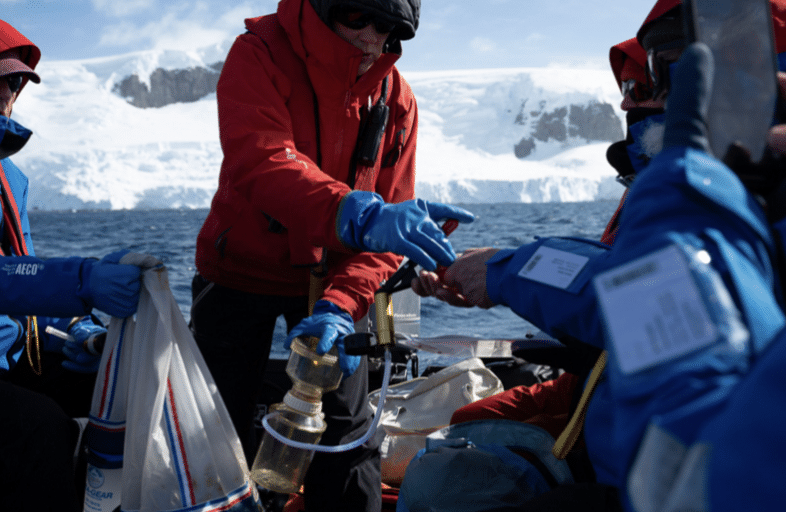
Across 11 voyages, 18 scientists will join AE Expeditions ships to conduct active Antarctic research, turning the company’s vessels into floating platforms for fieldwork spanning whale ecology, penguin populations, wildlife health, marine biodiversity and deep-sea exploration.
And among the research is an ambitious attempt to observe one of the Southern Ocean’s great mysteries: the colossal squid in its natural habitat.
Sailing aboard the Greg Mortimer, Sylvia Earle and Douglas Mawson, AE Expeditions’ 2026–27 itineraries range from nine to 34 days, reaching the Antarctic Peninsula, Antarctic Circle, Weddell Sea, South Georgia, Falkland Islands, Ross Sea and East Antarctica.
With a maximum of 130 expeditioners per polar departure, the voyages retain AE Expeditions’ small-group approach while giving travellers the rare opportunity to experience Antarctic science as it happens.
“Antarctica has always been at the heart of AE Expeditions, and this season really demonstrates how expedition travel is evolving,” said Sasha Buch, Head of Sustainability, AE Expeditions.
“Expeditioners come to experience extraordinary landscapes, wildlife and adventure, but increasingly they can also become part of the story of Antarctic science. Having researchers working directly from our ships – counting penguins, studying whales, monitoring wildlife health or searching the deep ocean for a colossal squid – brings another dimension to the experience. Expeditioners aren’t simply learning about Antarctica; they are travelling alongside scientists who are working to better understand and protect it.”
18 scientists. 11 voyages. Five Antarctic research projects.
Science will be a major focus of the 2026–27 season, with five research projects and scientific partnerships bringing 18 scientists aboard 11 voyages.
Using AE Expeditions’ ships as platforms for fieldwork, researchers will undertake hands-on studies while sharing their work directly with expeditioners through onboard presentations, interpretation and informal opportunities to learn about their research.
Whales
The Friedlaender Lab at the University of California, Santa Cruz will study Antarctic whale ecology, behaviour and health using observations, calibrated drone imagery and minimally invasive sampling. The team includes Professor Ari Friedlaender, who has worked in Antarctica for 30 years, and Chris Johnson, WWF Global Lead of the Protecting Whales & Dolphins Initiative.
Penguins
Six scientists from Oceanites will contribute to the long-running Antarctic Site Inventory, using ground and drone surveys to monitor penguin abundance, breeding activity and population change across selected sites on the Antarctic Peninsula.
Wildlife health
Researchers from the Institute for Marine and Antarctic Studies (IMAS), University of Tasmania, will investigate the health of whales, seals and seabirds, including pathogen surveillance and the impacts of environmental variability and climate change on Antarctic predators and ecosystems.
Marine biodiversity
Researchers from Reef Life Survey and the University of Tasmania will conduct standardised underwater biodiversity surveys, adding Antarctic observations to a global dataset designed to detect long-term changes in marine ecosystems.
The colossal squid
On Epic Antarctica: Crossing the 7th Continent, scientists from the Museum of New Zealand Te Papa Tongarewa and Auckland University of Technology will undertake Project ESCA — deploying a specially developed deep-sea camera and attraction system in an attempt to observe the elusive colossal squid in its natural Southern Ocean habitat.
The scientific teams bringing their research to sea include marine ecologists, wildlife biologists, drone pilots, deep-sea technologists and conservation specialists.
For expeditioners, that means the science isn’t confined to a laboratory or a lecture. It is happening around them, in some of the planet’s most remote environments, with researchers collecting observations and data as the voyages unfold.
For more information on AE Expeditions’ 2026-27 Antarctica voyages, visit www.aexpeditions.co.uk.